



Best Practice Recommendations for Inclusive Matchday Experiences
Best Practice Recommendations
for Inclusive Matchday Experiences
The recommendations below outline practical measures that can strengthen disability access and inclusion across the matchday experience. They address both the physical conditions of access (for example, routes, seating, sightlines, facilities, and the concourse environment) and the organisational arrangements that determine whether provision works reliably in practice (including information, staff awareness, and responsive processes).
Overall, the recommendations are intended to support greater comfort, confidence, independence, and choice for disabled supporters, recognising that barriers often arise through a combination of design, communication, and day to day delivery.
A particular focus is placed on the away-match context, where unfamiliarity with a ground and a greater reliance on pre travel planning can increase uncertainty and limit spontaneity. In these settings, accessibility depends heavily on accurate, easy-to-find information; predictable arrangements for parking and arrival; consistent steward practice; and comparable provision for seating, shelter, and essential services.
The recommendations therefore emphasise not only what should be available, but also how it is communicated and delivered, so that disabled fans can follow their team away from home with greater confidence and fewer avoidable disruptions.

Better and more Accessible Information
Make accessibility information easier to find and keep it up to date. Supporters should be able to quickly access details on parking, entrances, seating, facilities, availability of accessibility tools and transport links. This should be available in multiple forms, whether that be on a website, in an App or on social media. This is all especially important for away fans.
Accessible Routes
Create clearer, safer and more accessible routes into and around stadiums. Some routes around stadiums can become overcrowded, or lack resting seating areas, which can cause some areas of the stadium to be inaccessible to some.
Seating and Viewing Areas
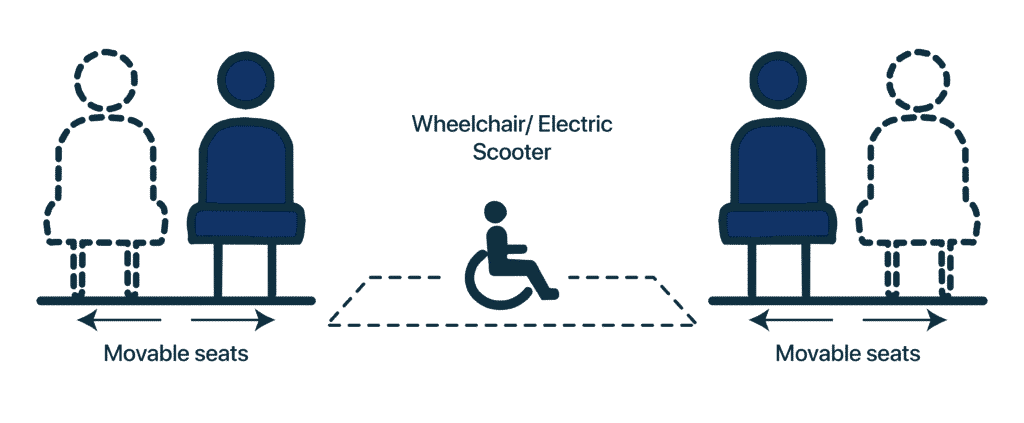
Improve seating and viewing provision for disabled supporters, especially wheelchair users. This could include raised viewing platforms. Where that is not possible, there should still be good sightlines (e.g., ensuring there are no bars/rails obstructing the view), and make sure non-disabled fans and/or stewards do not stand in front of wheelchair users or block their line of sight.
Flexible Seating
Introduce more flexible seating arrangements for disabled fans and their companions. This would allow clubs to better respond to different needs and give supporters more choice over who they sit with.

Accessible Parking and Entry
Increase the amount and reliability of accessible parking at football grounds. This was seen as especially important at away matches, where parking can often be limited or difficult to access. These should be as close to the stadium itself as possible, with accessible entry points that avoid turnstiles (e.g. staffed gate or large door) and a step-free route.
Coach Arrival and Drop Off
Allow disabled supporters travelling by coach to disembark as close to the ground as possible via an agreed drop off point. Ensure stewards are briefed in advance so the arrangement is applied consistently, and supporters are supported on arrival.

Handrails and Practical Changes
Add practical features that improve movement and safety around the ground. This should include ramps to key areas, such as away ends or the club shop and ticket office. Further changes such as handrails can also make a clear difference to the overall matchday experience.
Away Fan Provision for Wheelchair Users
Increase the number of wheelchair accessible spaces available for away supporters. Ensure that these spaces are in sheltered areas, or that adequate weather protection is provided. Where supporters are likely to be exposed to cold conditions, provide blankets on request. Better provision would make it easier for disabled fans to follow their team away from home.

Accessible Concourse Areas
Ensure concourse areas are accessible to disabled supporters. These spaces should be step-free, sheltered and easy to reach, so disabled fans can use the same shared areas as other supporters. Make sure that where one or multiple lifts are provided, a ramp is also in place so that in case the lifts are out of order, fans have another option to access or exit the premises.

Accessible Food and Drink Provision
Provide accessible ways for disabled supporters to view menus and order refreshments, especially where it is difficult to reach kiosks. This can include laminated and Braille menus in kiosks areas and in the seating area, and an accessible App based ordering option, with delivery to seats for those who need it, which may be particularly suitable for smaller grounds. For larger grounds, ensure kiosks and concourse areas are accessible, including step free routes, clear signage, lower counters for wheelchair users, and payment terminals that are usable for blind and partially sighted supporters, avoiding flat screen only systems.

Accessible Toilets
Provide accessible toilets across the stadium, available to all fans regardless of where they are seated. Ensure there are clear access routes to these, and they are regularly maintained.

Audio Descriptive Commentary
Provide audio descriptive commentary at every ground for blind and partially sighted supporters. This was seen as an important step in making the live match experience more accessible. Ensure that information about this provision is accurate and clear, confirming that the service is audio descriptive commentary rather than local radio or standard match commentary, and explaining how supporters can access it on the matchday.

Assistive Technology
Expand the use of assistive technology for disabled fans. Participants emphasised that emerging technologies which amplify residual vision and allow people with sight loss to experience live events firsthand could be used more extensively.
Sensory and Specialist Facilities
Provide a wider range of accessible facilities, including sensory rooms and stoma toilets. This would help clubs better support disabled supporters with different needs.

Inclusive Matchday Communication for Deaf or Hearing-Impaired Supporters
Provide clear, consistent match information in visual formats so that deaf supporters are not left feeling lost during key moments, including decisions, delays, and announcements. This can be delivered through stadium screens and captioned content, supported where possible by BSL interpretation, and reinforced through the club app or other written channels so that information is accessible without relying on audio.

Deaf awareness training for personnel
Provide deaf awareness training for all matchday staff, particularly those in kiosks and other customer facing roles. Staff should understand that some deaf supporters may communicate by pointing or indicating items. Kiosks should have clear written menus available on request. Where possible, a small number of stewards should have basic British Sign Language skills to support communication when needed.

Steward Training
Improve disability awareness training for stewards across the game. This should include a better understanding of visible and invisible disabilities, as well as stronger training for contract and agency staff. This is particularly important for away-end stewards, where there is less familiarity with away fans.
Acting on Feedback
Undertake regular consultations with disabled fans and implement practical improvements based on the feedback received, with clear communication about what will be changed and when. Disabled fans particularly value having conversations with follow-up improvements and seeing that all types of disability are considered.